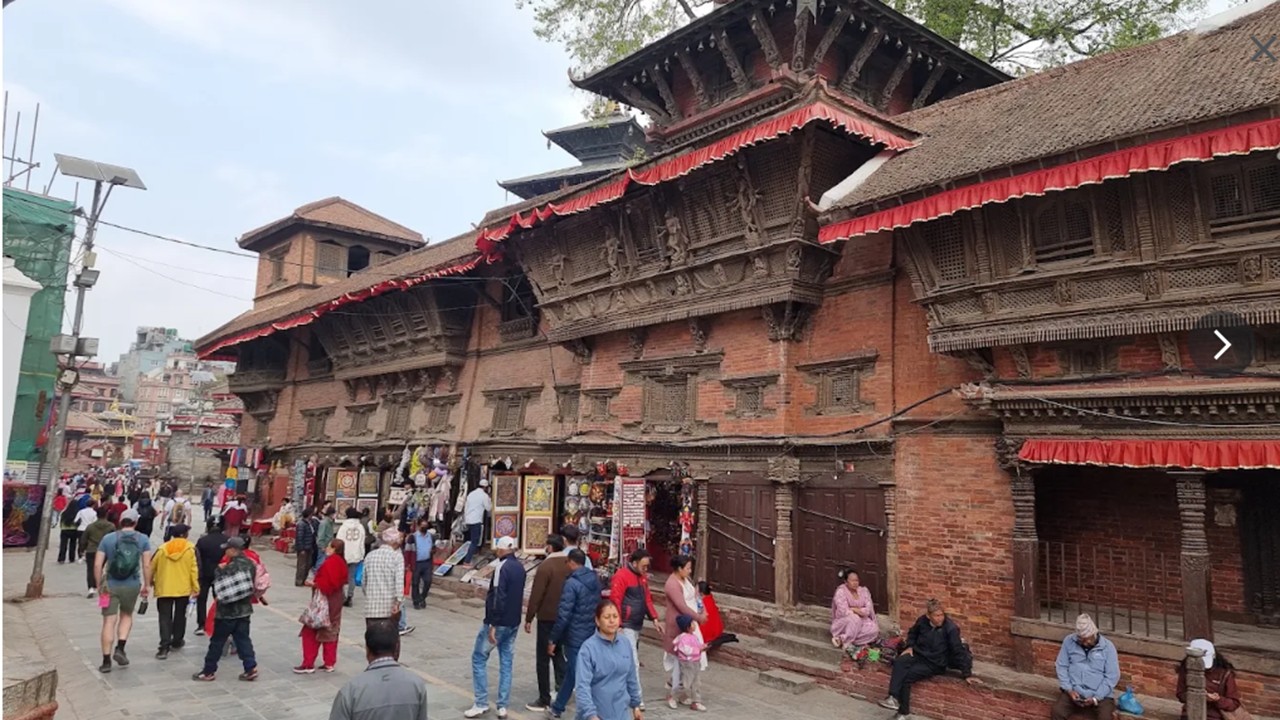
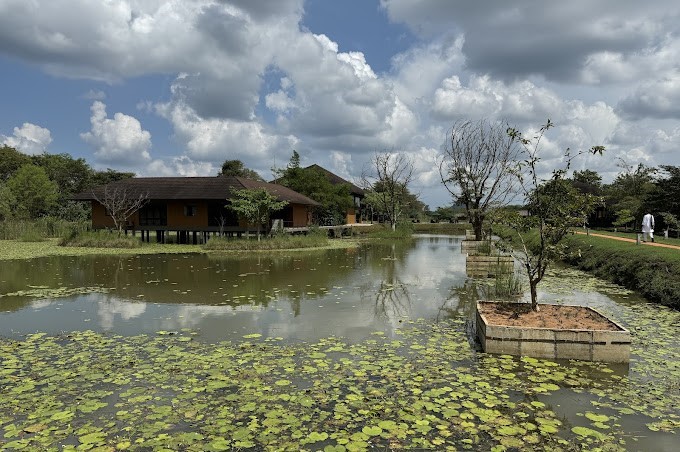
ISVS-15 conference will be held from 02-04 December 2026, hosted by the International Centre for Interdisciplinary Heritage Stuides (ICIHS), Kathmandu University, Nepal; International Society for the study of Vernacular Settlememnts (ISVS) and the Asian School of Knowledge (ASK) of Sri Lanka. The conference will explore the significance of living vernaculars: heritage, resilience and innovations in the contemporary world and inspire the young designers to create culturally relevant poetics of spaces and things. ISVS-14 took place within the premises of the HUTECH University in Vietnam at its wonderfully articulated academic setting, with an exhibition of design students work. ISVS-14 received 112 paper proposals of which 98 were accepted for presentation. It was a great event marking a milestone in the ISVS international movement. It is predicted that ISVS-15 in Nepal will be even a more significant event with a series of workshops prior to the event to be followed by a prolific set of paper presentations.
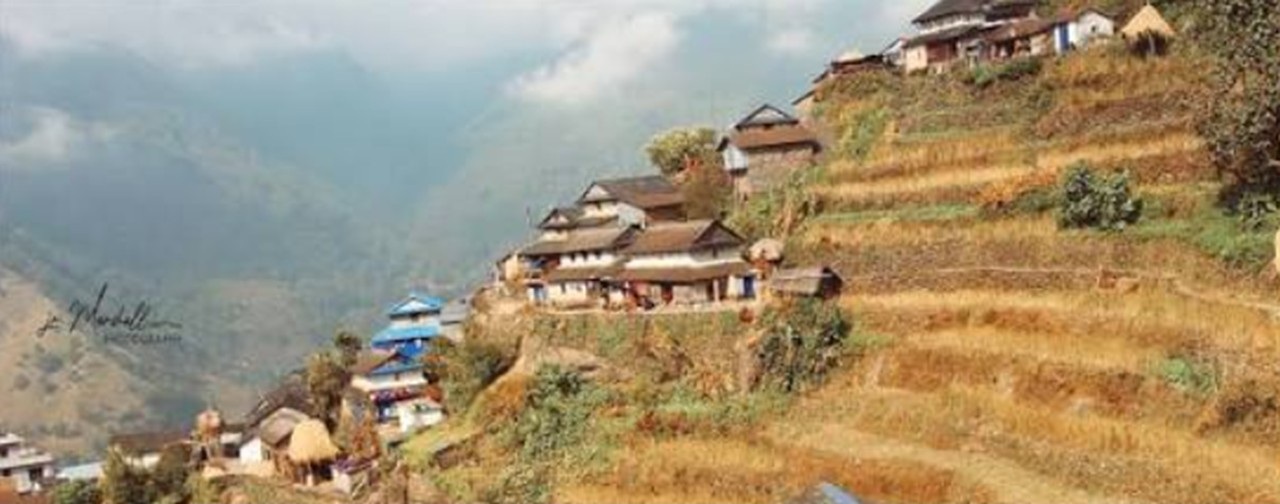
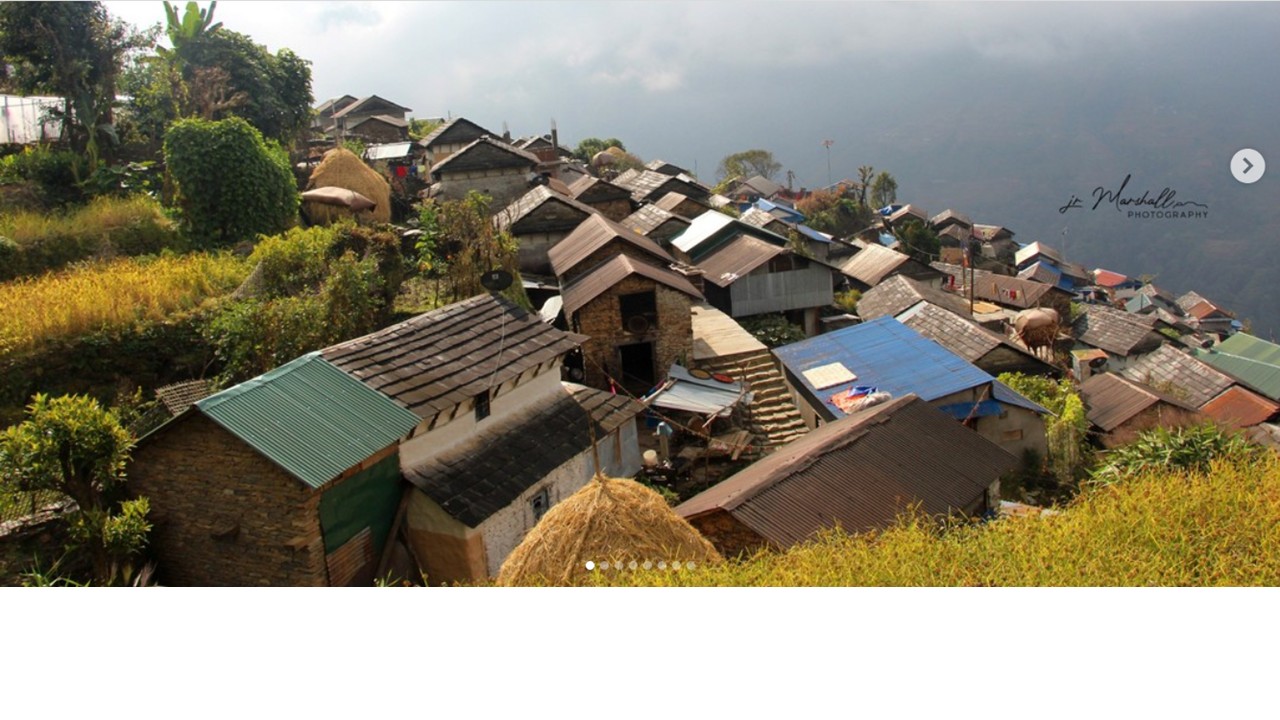
ISVS-15 will be held on the theme 'living vernaculars: heritage, resilience and innovation - The relevance of vernacular in the contemporary world.' Nepal has many mounteneous traditional settlements, historical sites and Nature among a thriving traditional community. In fact, there is no better place to continue the journey of ISVS than Nepal at this moment of time, with its breath-taking landscape and the traditional settlements as well as historical monuments facing the impacts of climate change and other disasters that call for a serious academic attention to reselience and innovation. It wil be hosted by the International Centre for Interdisciplinary Heritage Studies (ICIHS) at Kathmandu University, located in one of the best settings for the event with its natural, cultural and historic setting.
As said, ISVS-15 is earmarked to be one of the most exciting events in 2026 with an exhibition of the work of the architecture students from Kathmandu University and the visits to the fascinating places in the Kathmandu Valley: Banepa/Dhulikhel/Panauti and others.Please also visit the conference announcement of Kathmandu University available at https://icihs.ku.edu.np/conferencedec26/

Conference Convener: Prof. Neel Kamal Chapagain, International Centre for Interdisciplinary Heritage Studies (ICIHS), Kathmandu University, Nepal.
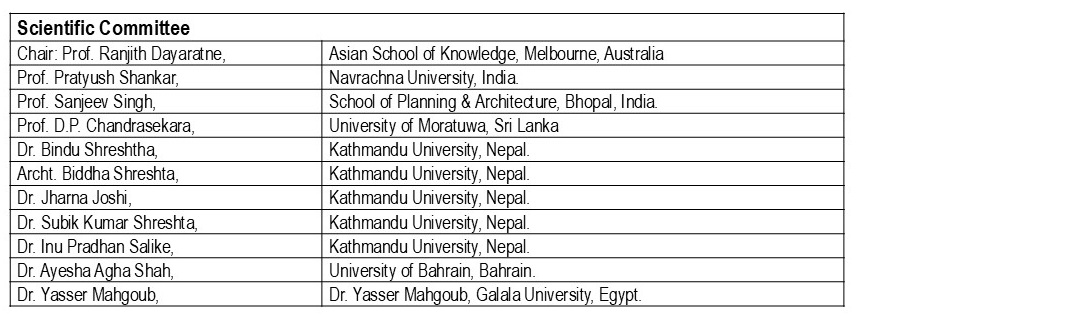
Keynote Speaker 1: Prof. Pratyush Shankar, Navrachna University, India.
 Prof. Pratyush Shankar is an Architect by profession and is presently the Provost and the Dean of School of Environmental Design and Architecture (SEDA), Navrachana University in Vadodara, India. Before joining the Navrachana University, Prof. Pratyush was the Acting Dean of Architecture and Head of the Undergraduate Program at CEPT University where he had taught for more than two decades.
He was recently honored as the International Ambassador for the University of Bonn, Germany and was also awarded the Alexander Von Humboldt Senior Fellowship in 2015 -17 and was hosted at the University of Bonn, Germany. His recent publication with the Oxford university Press is titled “History of Urban Form: India”. He has also authored the book titled “Himalayan Cities: Settlement Pattern, Public Places and Architecture” published by Niyogi Publishers, New Delhi, 2014. He is presently also a Guest Professor at the Mundus Urbano Program at Architecture Faculty, TU Darmstadt, Germany.
Pratyush runs a design practice along with his academic work. He was awarded the 22nd J K Cement Architect of the Year award 2013 in Residence Design Category, and has designed and built a large number of residential and commercial buildings in India. He won the Architect of the Year National Award for “Residence for three Artists”, by J K Cement, 2012. In fact, in his early career, he won the ‘Young Designer of the Year’ award in 2000: A Competition by ‘Indian Architect & Builder’, Mumbai, India.
He is also the founder of CityLabs India, an initiative to improve urban research, training and raising awareness of the Indian Cities. He was the Creative Lead – Humboldt Residency Program 2023 – Our Precious Resources and delivered the Humboldt KOSMOS LECTURE in September 2023, Berlin. He has been honoured as the International Ambassador for the University of Bonn, Germany in 2022, and has been awarded Alexander Von Humboldt Fellowship, Germany in Experienced Researcher category in November 2014-17. He has also been hosted at the Universitat Bonn, Germany and has been awarded Ford-Asia Fellowship 2008-09 by the Asia Fellowship Foundation, Bangkok for the study titled “Is there something like a Himalayan City” in Nepal. Hence, there is none better suited to deliver the main keynote speech at ISVS-15 in Nepal.
Prof. Pratyush Shankar is an Architect by profession and is presently the Provost and the Dean of School of Environmental Design and Architecture (SEDA), Navrachana University in Vadodara, India. Before joining the Navrachana University, Prof. Pratyush was the Acting Dean of Architecture and Head of the Undergraduate Program at CEPT University where he had taught for more than two decades.
He was recently honored as the International Ambassador for the University of Bonn, Germany and was also awarded the Alexander Von Humboldt Senior Fellowship in 2015 -17 and was hosted at the University of Bonn, Germany. His recent publication with the Oxford university Press is titled “History of Urban Form: India”. He has also authored the book titled “Himalayan Cities: Settlement Pattern, Public Places and Architecture” published by Niyogi Publishers, New Delhi, 2014. He is presently also a Guest Professor at the Mundus Urbano Program at Architecture Faculty, TU Darmstadt, Germany.
Pratyush runs a design practice along with his academic work. He was awarded the 22nd J K Cement Architect of the Year award 2013 in Residence Design Category, and has designed and built a large number of residential and commercial buildings in India. He won the Architect of the Year National Award for “Residence for three Artists”, by J K Cement, 2012. In fact, in his early career, he won the ‘Young Designer of the Year’ award in 2000: A Competition by ‘Indian Architect & Builder’, Mumbai, India.
He is also the founder of CityLabs India, an initiative to improve urban research, training and raising awareness of the Indian Cities. He was the Creative Lead – Humboldt Residency Program 2023 – Our Precious Resources and delivered the Humboldt KOSMOS LECTURE in September 2023, Berlin. He has been honoured as the International Ambassador for the University of Bonn, Germany in 2022, and has been awarded Alexander Von Humboldt Fellowship, Germany in Experienced Researcher category in November 2014-17. He has also been hosted at the Universitat Bonn, Germany and has been awarded Ford-Asia Fellowship 2008-09 by the Asia Fellowship Foundation, Bangkok for the study titled “Is there something like a Himalayan City” in Nepal. Hence, there is none better suited to deliver the main keynote speech at ISVS-15 in Nepal.
Keynote Speaker 2: Prof. Sudarshan Raj Tiwari, Nepal
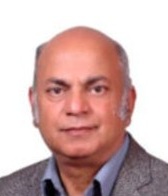 Prof.Sudarshan Raj Tiwari is an emeritus Professor of Architecture of Thibuvan University, Nepal. He has a Bachelor’s degree in architecture (1973) from the School of Planning and Architecture, University of Delhi. He also has a Master’s degree in Architecture (1977) from the University of Hawaii, USA, specializing in housing in tropical countries. His Ph.D. from Tribhuvan University (1995) is for his dissertation on ancient settlements of the Kathmandu Valley. He has served the Institute of Engineering, Department of Architecture, the faculty of Tribhuvan University for 40 years and has been the Dean of the Institute for four years. Among his publications are: The Brick and the Bull: An account of Handigaun, the ancient capital of Nepal (2001) and Temples of Nepal Valley (2009). Visit www.kailashkut.com for his publications historical culture, architecture, and urbanism in Kathmandu. At this keynote, he will share his deep insights on living vernaculars of Nepal.
Keynote Speaker 3: Prof. Achyut Prasad Wagle, Former Vice-Chancellor, Professor of Economics, Kathmandu University, Nepal.
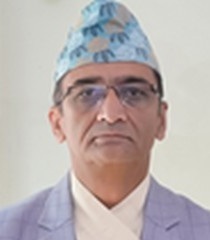 Prof. Achyut Prasad Wagle is the former Vice-Chancellor of Kathmandu University. Earlier, he held the positions of Registrar of the university, Associate Dean of the School of Management, and Head of the Management Science Department at the School of Management. He holds a PhD in Economics from the Indian Institute of Technology Kanpur, an MSc in Economics from the University of Birmingham, UK and an MA from Tribhuvan University, Nepal. Prof. Wagle has also held several important public positions including Advisor to the Prime Minister of Nepal and Advisor to the Governor of Nepal Rastra Bank, the Central Bank of the country. He is a seasoned fortnightly columnist for The Kathmandu Post and Kantipur, the most popular daily newspapers in Nepal. He teaches Econometrics and other core courses on economics and research. His research interests include business environment, regional economy, fiscal federalism and entrepreneurship.
The Conference Theme
Living Vernaculars: Heritage, Resilience and and Innovation: Survival and evolution of vernacular have been more about preserving the knowledge systems that have evolved around their contextual relationships, the practices that make them sustainable, and the contextual adaptability that makes them resilient, rather than merely the tangible components of them. Understanding the living vernaculars therefore gives us an opportunity for an intellectual interpretation that includes climate change, seismic resilience, traditional knowledge, cultural landscapes, adaptive transformations and contemporary constructions. Vernacular heritage as such is not just a collections of traditional buildings that are static, but are intertwined systems with complex cultural landscapes that incorporate the tangible and intangible dimensions such as settlement patterns, buildings, materials and construction systems, craftmanship, social practices, rituals, collective memories, beliefs, livelihoods and their relationships with the natural landscape. An understanding of how vernacular processes are produced, transmitted, adapted and transformed, will thus be of immense value in the contempporary world.This conference brings together the intertwined yet distinct areas of inquiries outined below together to contribute to such an outcome. The ISVS-15 conference invites the scholars dealing with vernacular settlements and cultural heritage to explore the numerous ways and means of understanding cultural heritage. These may include oral, verbal as well as manual documentations, not to mention other means such as buildings and structures, manuscripts and traditional ways of keeping the memories of such heritage alive along with the most modern digital technologies. You may propose written reserach papers for presentations or posters produced from research.

Accordingly, following sub-themes are suggested, but the papers are not limited to these themes. Other innovative papers can also be presented.
Sub Theme-1
Vernacular Systems as living Heritage: Living continuity of culture, place and Identity
Theme 1-a: Culture, Memory and Identity of Vernacular Settlements
Theme 1-b: Vernacular Settlements as Tangible and Intangible Heritage
Theme 1-c: Vernacular Communities, Social Practices and Place Making
Theme 1-d: Collective and Personal Memories as tools of Cultural identity and Lived Experiences
Sub Theme-2
Vernacular Intelligence, Practices and Transmissions
Theme 2-a: Indigenous and Vernacular Intelligence
Theme 2-b: Traditional Craft, Material culture and Making
Theme 2-c: Traditional Technologies and Practices
Theme 2-d: Place-based Ecological Knowledge Systems
Theme 2-e: Knowledge Transfer and Inter-generational Learnings
Sub Theme-3
Vernacular Systems, Ecological Change and Resilience
Theme 3-a: Climate Change, Risks and Resilience of Vernacular Systems
Theme 3-b: Human-Nature Relationships and Evolving Cultural Landscapes
Theme 3-c: Environmental Change and Vulnerability of Vernacular
Theme 3-d: Vernacular Territories, Settlements and Ecological Systems
Sub Theme-4
Adaptations and Transformations of Living Vernacular to Contemporary Challenges
Theme 4-a: Imagining Continuity and Change through Revitalization and Regeneration
Theme 4-b: Inclusive and Participatory Heritage Future for Living Vernacular
Theme 4-c: Adaptive Conservation and Transformations of Vernacular
Theme 4-d: Innovations and Digital Transformations of Vernacular Systems
Other Sub Themes
Vernacular Settlements, Traditions, and Culture
This sub-theme explores the spatial, social, and cultural logic of vernacular settlements shaped by climate, geography, belief systems, and collective memories. Papers may investigate settlement patterns, dwelling typologies, social structures, rituals, and everyday practices that inform the making and habitation of vernacular environments, as well as their transformations under modern influences.
Vernacular and Traditional Landscapes
Traditional landscapes embody centuries of interactions between people and Nature. This sub-theme focuses on cultural landscapes such as agricultural systems, water management practices, sacred geographies, pastoral terrains, and indigenous land-use patterns. Contributions may address landscape resilience, ecological balance, and the cultural meanings embedded in traditional environmental practices.
Engaging Traditional Values and Elements in Interiors
Interiors serve as intimate expressions of cultural identity and social values. This sub-theme examines how traditional materials, crafts, spatial hierarchies, symbolism, and sensory qualities inform interior environments. It also invites explorations of how these elements are reinterpreted in contemporary interior design while retaining cultural authenticity.
Traditional Furniture and Contemporary Innovations
Traditional furniture reflects local lifestyles, craftsmanship, ergonomics and material wisdom. This sub-theme invites studies on indigenous furniture traditions, making techniques, joinery systems and material cultures, as well as contemporary innovations that reinterpret traditional forms for modern living, production methods and sustainability goals.
Inventing Contemporary Fashions from Traditional Dresses and Motifs
Clothing and adornment are powerful carriers of cultural narratives. This sub-theme explores how traditional textiles, garments, motifs, weaving techniques and ornamentations inspire contemporary fashion and design. It encourages discussions on cultural continuity, ethical productions, identity, and innovations in fashions rooted in vernacular traditions.
Conservation of Traditional Heritage and Policies
This sub-theme addresses theoretical, methodological and policy-related dimensions of conserving vernacular and traditional heritage. Contributions may examine conservation philosophies, community participation, legal frameworks, adaptive reuse, heritage economics, and the challenges of safeguarding living traditions in the face of development pressures.
Traditions of Music and Performing Arts
Music, dance, and performances are integral to vernacular cultures and spatial practices. This sub-theme invites interdisciplinary inquiries into how performing arts shape social spaces, rituals, festivals, and collective memories, and how these traditions adapt, survive, or transform in contemporary contexts.
Earthen Architecture & Sustainable Materials: Bamboo, Straw, and Earth
Focusing on material intelligence, this sub-theme examines earthen construction and renewable materials such as bamboo and straw, emphasizing their climatic responsiveness, low carbon footprint, and cultural significance. Papers may address traditional building techniques, modern adaptations, structural innovations and policy challenges in mainstreaming these materials.
Manifestations of Traditions and Graphics in Human Settlements
This sub-theme explores visual expressions of culture in settlements such as murals, symbols, signage, patterns, colors, scripts, and craft-based graphics. It examines how graphic traditions contribute to identity, legibility, storytelling and sense of place in both traditional and contemporary environments.
Traditions and Culinary Arts
Food traditions are deeply tied to geography, climate, social practices and cultural memories. This sub-theme investigates vernacular culinary practices, food spaces, traditional cooking techniques and rituals, as well as their role in sustaining cultural identity, livelihoods and community cohesion.
Vernacular Architecture and Sustainability
This sub-theme focuses on the intrinsic sustainable practices embedded in vernacular architecture, including passive design strategies, resource efficiency, adaptability, and long-term resilience. Contributions may analyze vernacular principles as models for sustainable design in contemporary architectural practices and urban developments.
Development and Cultural Change
Modern developments often bring profound cultural transformations. This sub-theme critically examines the interface between development, modernization, globalization, and cultural change, questioning how vernacular traditions negotiate continuity and transformations, and how developments can be reimagined to be culturally sensitive and inclusive.
Approaches to Architecture Promoting Traditions and Culture
This sub theme promotes the examination of the works of architects whose approaches to contemporary architecture are derived from the nuances of cultural practices of the ordinary people, vernacular and traditions. The papers can examine and reveal the already established or young architects work that include earth and straw, buildings, bamboo and other traditional materials as well those who employ traditional ideas and values.
An Invitation to Participate
ISVS-15 invites those who are involved in studying vernacular things and settings to focus attention to any of the above sub-themes under the main theme to propose research papers and presentations to be shared at the ISVS-15 conference in Nepal. This conference aims to foster critical dialogue, collaborative explorations, and creative experimentations, encouraging the participants to examine how the translation of traditions can produce new design vocabularies that are meaningful, ethical and contextually relevant. It is a call to re-imagine the past as a source of innovation, where tradition is not preserved merely for nostalgia, but transformed to address the pressing questions of our time. Through a series of keynote lectures, academic presentations, design case studies, exhibitions, and panel discussions, the conference invites architects, urbanists, planners, researchers, educators, and students to explore the intersections of vernacular heritage and their relevance in the contemporary world.Publication
ISVS-15 will first produce digital proceedings. However, selected papers from the ISVS-15 will have the opportunity to be published in the indexed journals such as the ISVS e-journal (To be Web-of-Science indexed soon), and Archi-Texts e-jouranl, Design Research e-journal, or the SAAAK e-journal (to be indexed soon) further contributing to the international academic discourse. We invite all the academics from around the world to be part of this significant event, exploring, exchanging, and expanding the discourse on heritage, culture, traditions and vernacular practices and contribute to advance the scholarship on vernacular heritage and simultaneously contribute to making a wholesome world.


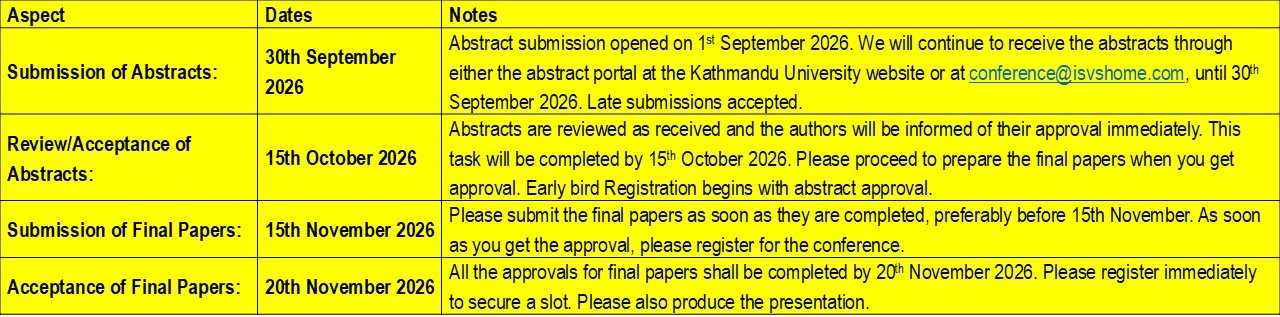
Please use the abstract template to prepare the abstracts. Once the abstracts are reviewed and accepted, authors must develop the final papers, which will be reviewed/revised/accepted for presentations. Final Papers must also use the template.
Download the Templates from Here
Submit the Abstracts and Final Papers to conference@isvshome.com, and Kathmandu University web portal.
Revised Fees
Please note that the fees announced earlier have been revised in response to many requests from the authors as follows. No further concessions are possible.
 Please note that the fee listed above in each category is for a single presenter. When there are a number of authors and all of them attend, then the first author/presenter must pay the full fee and the rest of the authors each should pay 50% of that full fee. The full payment so calculated must be mentioned in detail in the registration form, with the names of those who will attend. Please also note that, when such concessionary fees are paid, they will not be entitled to any complimentary accomodation being planned to be offered by the host:ICIHS to some of the deserving attendees. Moreover, names of those who do not attend and present, will not be mentioned in the final certificates for the presenters. Their names will remain only as authors of the papers and shall not be mentioned as presenters.
Registration
Please register through either the word document below or the Googe form available at the link below
Attendees: paper presenters and others need to register from 15th October 2026 to 20th November 2026 after the abstracts have been accepted for presentation. Please register as early as possible and get the benefit of the EBR - Eealy Bird Registration as announced in the fee table.
Please use Bank to Bank transfer with bank fees paid by you. Submit either of the completed registration forms, and follow the instructions there in. Bank Instructions for Payments are as followsLocal - Nepalese

International - All others

Opportunities are now available for Online Participation and Presentations. Please contact Ranjith Dayaratne at conference@isvshome.com, and indicate your interest to present online.
Concessions: If eligible, you may apply individually with University Support documents.
Please note that the registration deadline is 20th November 2026